Why Social Teams Route Around the DAM—and How a Smart DAM Brings Them Back
Social teams need more than a wall of search results. They need a fast path from a real post or idea to a ranked, explainable asset decision.
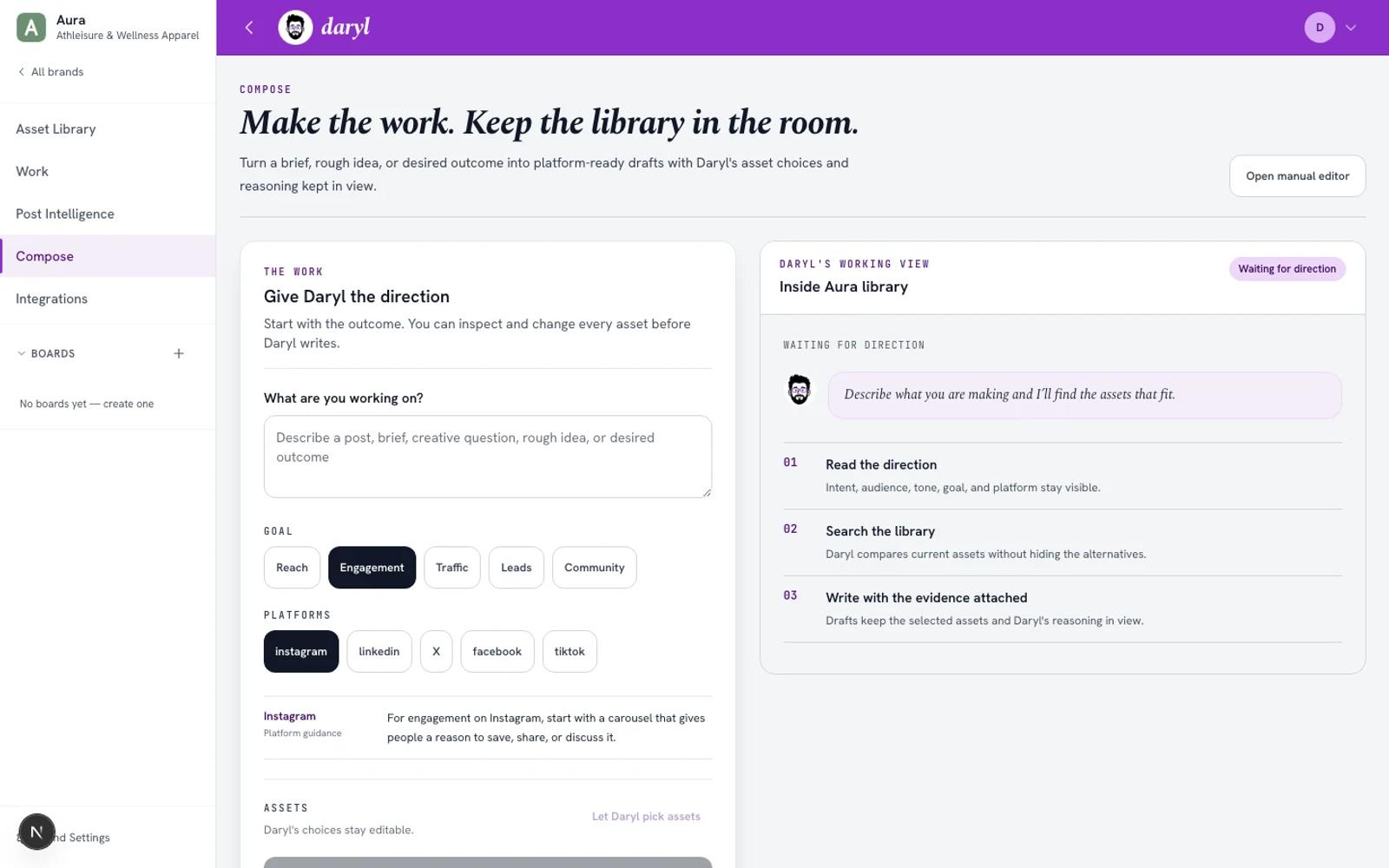
A social marketer rarely starts the day thinking, "I would like to browse the DAM."
They start with work in progress. A post is due. A launch needs energy. A caption is almost right, but the visual still feels generic. The library may contain hundreds or thousands of approved assets, yet the immediate question is small and specific:
Which of these assets should I use for this?
That is why social teams can route around an otherwise capable asset system. The library is organized around files. The marketer is organized around the work due next.
The answer is not to make the DAM less like a DAM. It is to connect the library to the decision.
Social teams still need the library
The foundation remains familiar:
- one approved place to browse brand assets;
- semantic search when the marketer knows what they want;
- filters and metadata when precision matters;
- visible source information;
- Work for saving, grouping, and sharing shortlists;
- asset detail that explains what is known about the file.
Removing those controls would make the product worse for the exact teams with sophisticated libraries.
The opportunity is to add a second path for the moments when search terms are not the natural input.
Post Intelligence starts with the work
Post Intelligence is DAMdaryl’s flagship social workflow.
The marketer brings a finished post, a rough caption, or a social idea. Daryl reads the message, tone, intended audience, platform context, and active Brand Context. He then searches the approved library and ranks the strongest candidates with a plain-English reason for each pick.
The result is not an invisible automated decision. The marketer can see:
- how Daryl interpreted the input;
- which concepts or signals he looked for;
- the leading asset and credible alternatives;
- why the assets were ordered that way;
- where the recommendation may be uncertain;
- how to refine or restart the request.
That visibility matters because a marketer may disagree. The brief may be intentionally breaking a familiar pattern. A campaign may need a quieter visual than the caption alone suggests. Daryl should support that judgment, not pretend to replace it.
A post is one input, not the product boundary
Social is a clear place to prove the value of work-based asset recommendations, but DAMdaryl is not only a caption-to-image tool.
The same entry model supports:
- a campaign brief;
- a creative question;
- a rough idea;
- a desired outcome;
- a direct request to find or compare assets.
If the user simply wants semantic search, the request stays in the library. If the request needs interpretation, comparison, and a saved decision trail, Daryl can route it into Work. The route is visible and editable.
That distinction keeps the product useful for two kinds of teams:
- a team that wants DAMdaryl to be its complete smart DAM;
- a team that already has an approved source and wants DAMdaryl to work across a supported connection.
Imagine the workflow with the decision in view
Imagine a marketer preparing a spring launch post. The direction is optimistic and capable, but the brand should still feel human.
They can search the library directly for "warm outdoor team, candid, confident" and use filters to narrow the results.
Or they can bring the full post to Post Intelligence. Daryl may identify launch momentum, human confidence, and an outdoor lifestyle cue; return a ranked shortlist; and explain that the leading asset feels immediate without becoming overly polished.
Both paths use the same approved library and Brand Context. The difference is the shape of the question.
What a better social-DAM relationship looks like
The social team should not need to abandon the library to move quickly. The DAM should meet them at the moment the visual decision is being made.
That means preserving the fundamentals of asset management while adding:
- natural-language discovery;
- work-aware recommendations;
- visible reasoning;
- alternatives instead of false certainty;
- a path from selection into saved Work, sharing, and Compose.
The DAM becomes more useful when it can answer both "What do we have?" and "What fits this?"
Post Intelligence is one focused answer to the second question. The smart DAM is the system that connects both.
Tell Daryl what you’re working on. Bring a real social post, or start with semantic search and use DAMdaryl as the library your team can actually work from.